
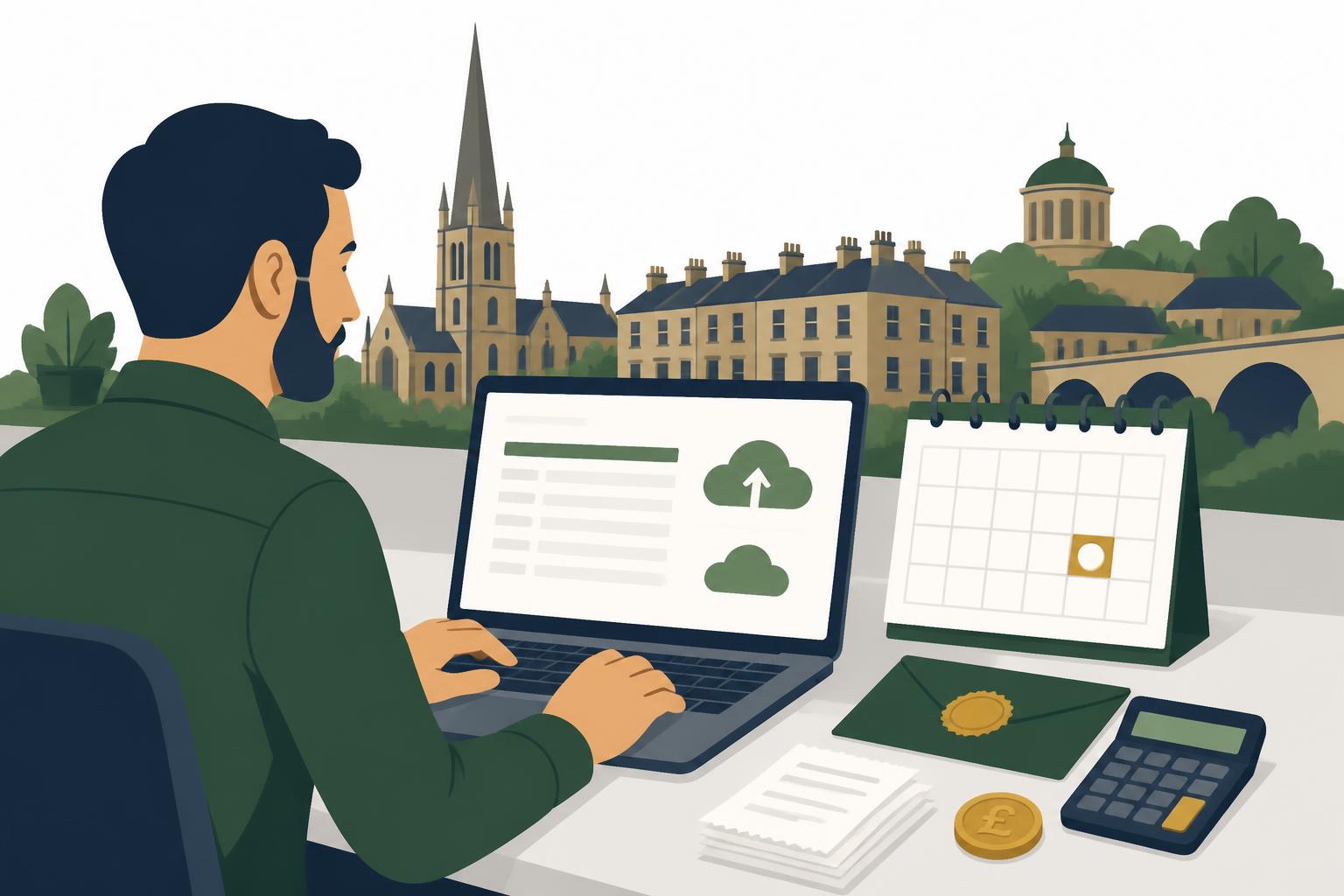
VAT returns for Blackburn businesses are due one calendar month and seven days after each VAT quarter ends, filed through Making Tax Digital software. You must register once taxable turnover passes £90,000 in any rolling 12 months.
VAT trips up more Blackburn small businesses than any other tax. Miss a deadline and HMRC’s penalty points start stacking up.
Register late and you can owe VAT on sales you never charged it on. Pick the wrong scheme and you can overpay for years without realising.
This 2026 guide covers the current thresholds, the deadlines to put in your calendar, how to file under MTD, and the mistakes we see most often across Lancashire.
1. What are the 2026 VAT thresholds for Blackburn businesses?
VAT registration in the UK is triggered by turnover, not profit. In 2026 the key thresholds are:
- Compulsory registration threshold: £90,000 of VAT-taxable turnover in any rolling 12-month period.
- Deregistration threshold: £88,000 if your taxable turnover falls below this.
- Voluntary registration: you can register at any turnover — often worth it if most of your customers are VAT-registered businesses.
- Flat Rate Scheme: available if your VAT-taxable turnover is £150,000 or less (excluding VAT).
- Cash Accounting Scheme: available up to £1.35 million turnover.
- Annual Accounting Scheme: available up to £1.35 million turnover.
The word “rolling” matters. HMRC doesn’t look at your accounting year. It looks at any 12 months.
If a Blackburn takeaway or a King William Street retailer hits £90,000 in the 12 months to, say, 30 April, they must register from 1 June. That is the first day of the second month after they went over.
2. When are VAT returns due in Blackburn?
Most Blackburn businesses file quarterly VAT returns. Your specific quarters (“stagger”) are set by HMRC when you register. The rule for every quarter is the same:
- File and pay within 1 calendar month and 7 days of the end of your VAT quarter.
So if your VAT quarter ends 31 March, your return and payment are due by 7 May. Quarter ending 30 June → due 7 August. Quarter ending 30 September → due 7 November. Quarter ending 31 December → due 7 February.
Other schemes:
- Annual Accounting Scheme: one return per year, due 2 months after year end, with 9 monthly payments on account plus a balancing payment.
- Payments on Account (large businesses over £2.3m VAT liability): monthly interim payments plus a balancing return.
Late filing penalties (points system): you get a penalty point for each late return. At 4 points for quarterly filers, a £200 penalty applies, plus another £200 for every further late return.
Late payment: interest runs from the day payment is late. A 3% penalty applies to tax still unpaid after 15 days, another 3% after 30 days, and from day 31 a daily penalty at 10% a year on the balance.
3. How do you file a VAT return under MTD in 2026?
Making Tax Digital for VAT applies to every VAT-registered business, regardless of turnover. You can no longer type figures into the old HMRC portal. You must:
- Keep digital records of every sale and purchase.
- Use MTD-compatible software to file the return (Xero, QuickBooks, FreeAgent, Sage or bridging software over a spreadsheet).
- Maintain digital links between your records and the return — no manual retyping.
The practical step-by-step for a Blackburn small business:
- Reconcile your bank in Xero / QuickBooks / FreeAgent up to the last day of the VAT quarter.
- Post all supplier bills and sales invoices for the quarter.
- Check VAT codes — standard 20%, reduced 5%, zero-rated, exempt, and no VAT are all treated differently on the return.
- Review the VAT return in your software and check the detailed transaction report for anything odd.
- Submit through the software’s MTD connection to HMRC.
- Pay by Direct Debit, Faster Payment or online banking using your 9-digit VAT registration number as the reference.
Setting up a VAT Direct Debit is the single easiest way to avoid late payment penalties — HMRC pulls the funds a few days after the deadline automatically.
4. Which VAT scheme should you choose?
- Standard VAT accounting: the default. You reclaim VAT on purchases and pay VAT on sales based on invoice dates — even if customers haven’t paid yet.
- Cash Accounting: you only pay VAT to HMRC when your customer pays you. Excellent for Blackburn service businesses with slow-paying clients.
- Flat Rate Scheme: you charge 20% VAT to customers but pay a fixed flat rate (between 4% and 14.5%, depending on your sector) to HMRC. Simpler but can be worse if you buy a lot of goods; watch out for the “limited cost trader” 16.5% rate.
- Annual Accounting: one return per year with monthly instalments — smooths cashflow.
- Retail schemes: for shops and takeaways selling to the public with mixed VAT rates.
- Margin schemes: for second-hand goods, antiques and used vehicle dealers.
A quick scheme review with an accountant when you first register, and again as you grow past £100k, £150k and £250k, is one of the most valuable conversations you’ll have all year.
What VAT mistakes do we see in Blackburn?
- Ignoring the rolling 12-month turnover test and registering months late.
- Reclaiming VAT on fuel or entertainment without applying the correct restrictions.
- Getting the reverse charge wrong on construction (CIS) subcontractor work.
- Charging VAT on zero-rated food or children’s clothing.
- Staying on the Flat Rate Scheme long after it stopped being profitable.
- Forgetting to include Amazon, Etsy, eBay and Shopify sales in taxable turnover.
Frequently Asked Questions
What is the VAT registration threshold in 2026?
You must register for VAT once taxable turnover exceeds £90,000 in any rolling 12-month period, or if you expect to exceed it in the next 30 days.
When are VAT returns due?
VAT returns and payment are due one month and seven days after the end of each VAT quarter. Most businesses file quarterly; annual accounting and monthly schemes are alternatives.
What is Making Tax Digital for VAT?
MTD for VAT requires all VAT-registered businesses to keep digital records and submit returns using compatible software (Xero, QuickBooks, FreeAgent and similar) via HMRC’s MTD API — no more manual entry on the HMRC portal.
What are the penalties for late VAT returns?
HMRC uses a points-based system — one point per late return, and a £200 penalty once you hit the threshold (4 points for quarterly filers). Late payment triggers interest from the day after the due date, a 3% penalty if tax is still unpaid after 15 days, a further 3% after 30 days, and a daily penalty at 10% a year from day 31.
The bottom line
VAT is one of the areas where a Blackburn accountant genuinely earns their fee. The right scheme, clean digital records, on-time VAT returns and a Direct Debit will keep HMRC off your back and can cut your VAT bill too.
If you’re within a few thousand pounds of the £90,000 threshold, or you haven’t reviewed your scheme in years, a 20-minute conversation with our VAT return service is worth having.
Related reading: Small business accountant in Blackburn: a founder’s guide, Does Making Tax Digital apply to sole traders?, and How much does an accountant cost in the UK?
Tax figures checked by Rehan Razzaq FCCA on 8 October 2026 for the 2026/27 tax year.
This article is general guidance for UK businesses and individuals and does not constitute personal financial or tax advice. Rules, thresholds and individual circumstances vary — always confirm your specific position with a qualified accountant before acting.

Rehan Razzaq, FCCA
Founder, R&R Chartered Certified Accountants
ACCA Chartered Certified and Xero Certified Advisor, helping Blackburn businesses and landlords with accounts, tax and financial planning since 2021.
We work with clients right across Lancashire and the North West. If you are looking for accountants in Blackburn, or a local accountant in Darwen or accountant in Chorley, our team is a short drive away.
VAT Return Deadline Looming? Let’s Handle It.
Book a free, no-obligation consultation with our Blackburn team and we’ll file your VAT return correctly and on time.
For the official position, see HMRC’s VAT Returns guidance on GOV.UK.
Related Articles
Small Business Accountant in Blackburn: A Founder’s Guide to Picking One
Does Making Tax Digital Apply to Sole Traders? 2026 Rules Explained
How to Keep Your Business Accounts Organised
Amazon FBA Accountant UK: The Complete Guide for Sellers on Tax, VAT and Bookkeeping
VAT Registration Threshold 2026: When to Register for VAT in the UK